★★★★★ 4.9 on Google · 16 reviewsLicensed, bonded & insuredOwner on every jobFree written estimates
Our approach
How we approach downspout drainage systems.
When downspouts dump at the foundation, that water soaks the soil right where you least want it. We connect downspouts to solid pipe, run it underground at a steady slope, and daylight it or finish it in a pop-up emitter far from the house.
Downspout drainage systems in Waxhaw, NC: moving roof water away for good
The short answer
A downspout drainage system connects each gutter downspout to buried solid pipe that carries roof water away from the house to a safe outlet such as a pop-up emitter in the lawn, a daylight outlet on a slope or a curb outlet where allowed. Pipe is laid at a steady slope, with cleanouts where needed, so rain from the roof never pools against the foundation.
01Why does roof water need to be piped away?
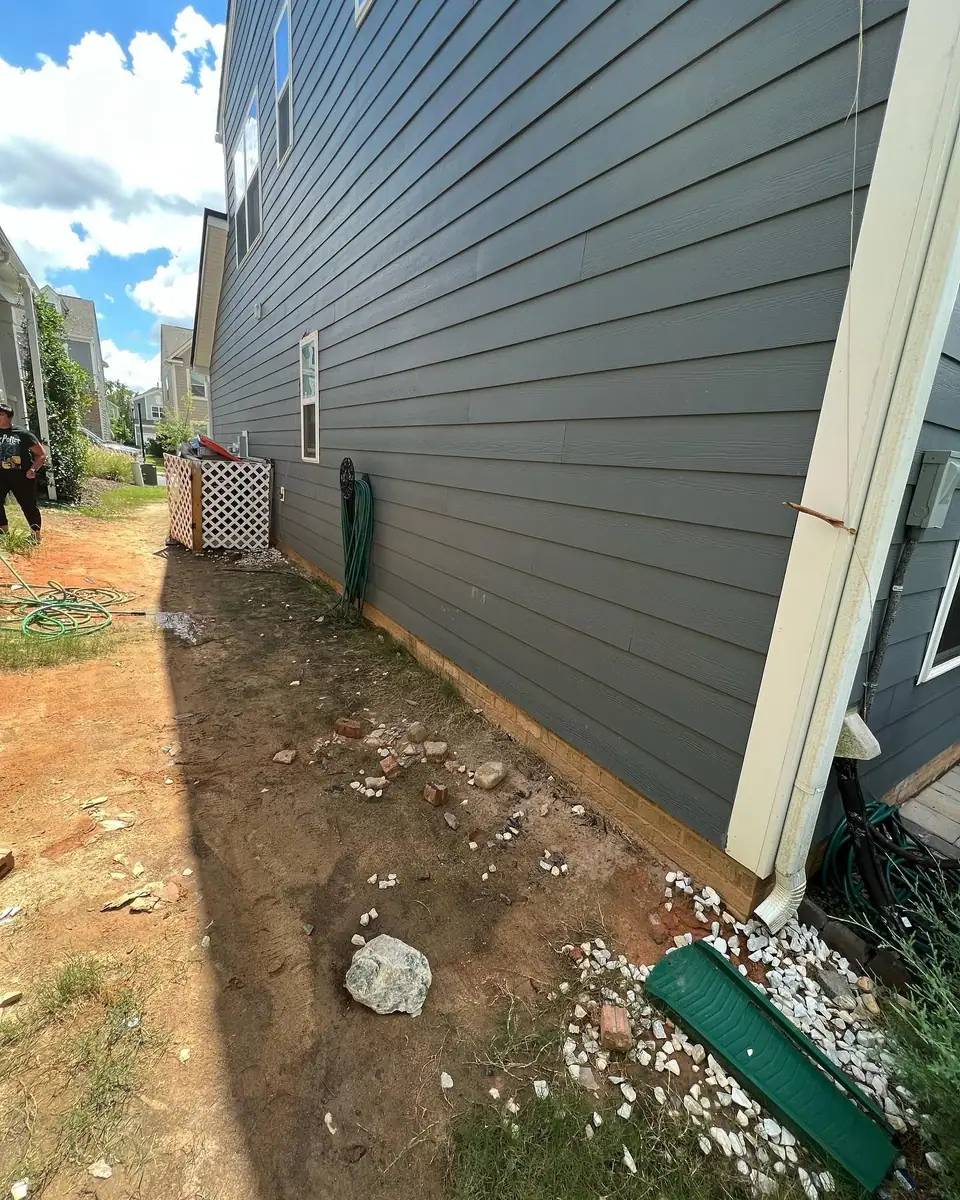
A roof sheds an enormous amount of water. Even a modest storm on an average-sized house sends hundreds of gallons through the gutters, concentrated into a handful of downspouts. If those downspouts discharge onto splash blocks a foot or two from the wall, all of that water soaks into the clay right beside the foundation.
Red clay expands when it is saturated and shrinks as it dries, which stresses foundation walls and slabs over time. Saturated soil also feeds damp crawl spaces, basement seepage, wood rot and erosion of beds along the house. Piping roof water away is one of the simplest ways to protect a home in the Carolinas.
Foundation: keeps clay beside walls from saturating
Crawl spaces: reduces moisture and musty odors
Beds: stops mulch and soil from washing out
Walks: prevents icy patches and algae on concrete
Lawn: eliminates soggy strips along the house
02How is a buried downspout system installed?
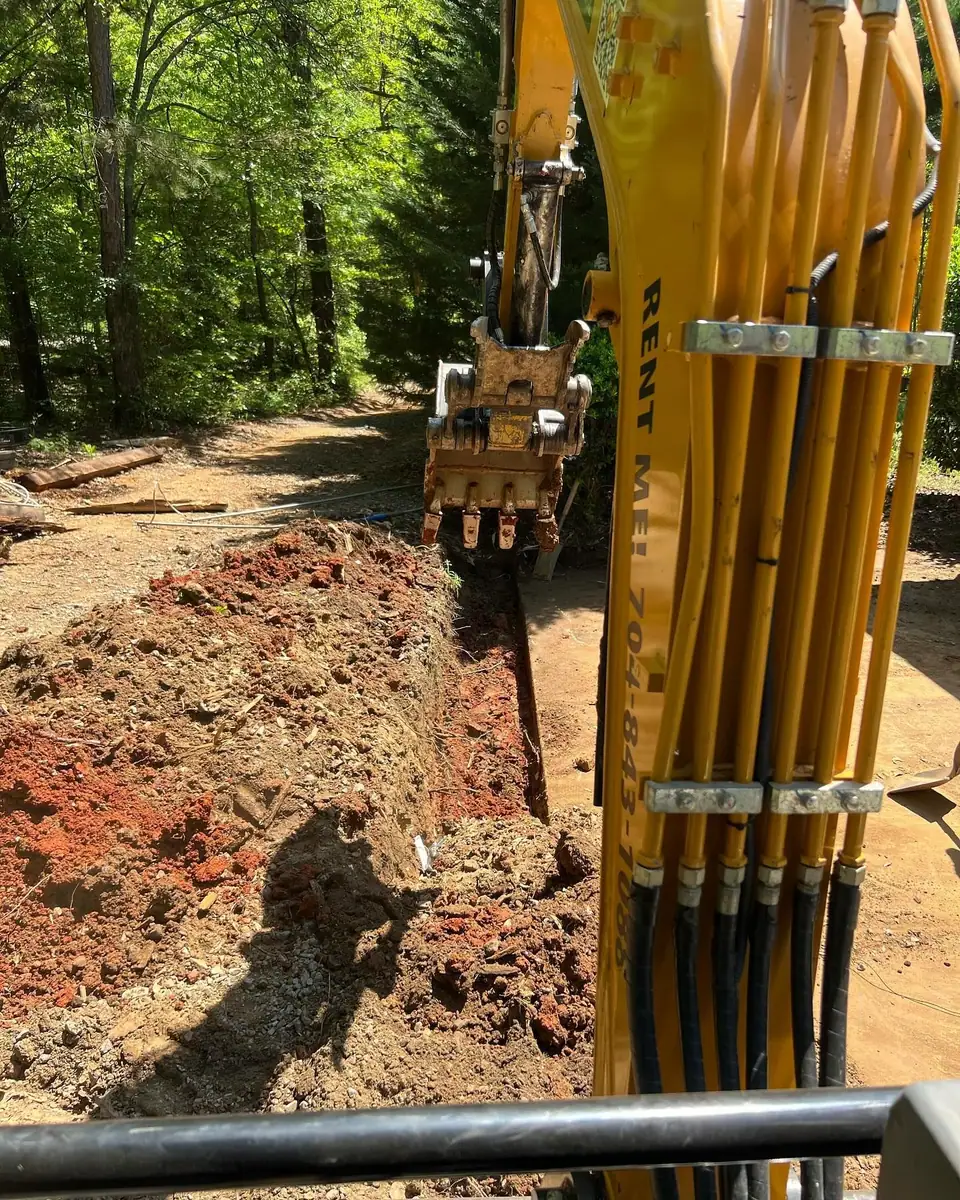
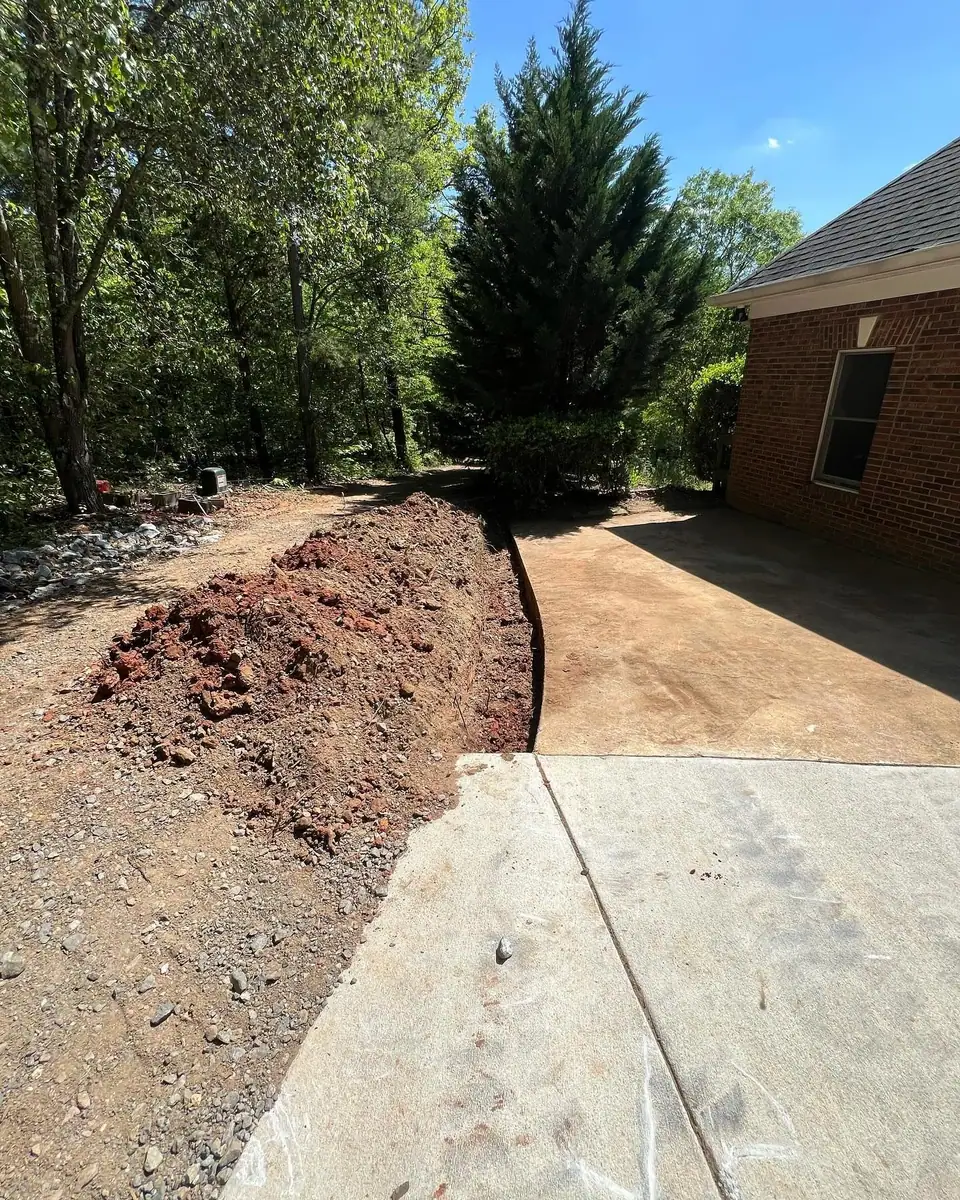
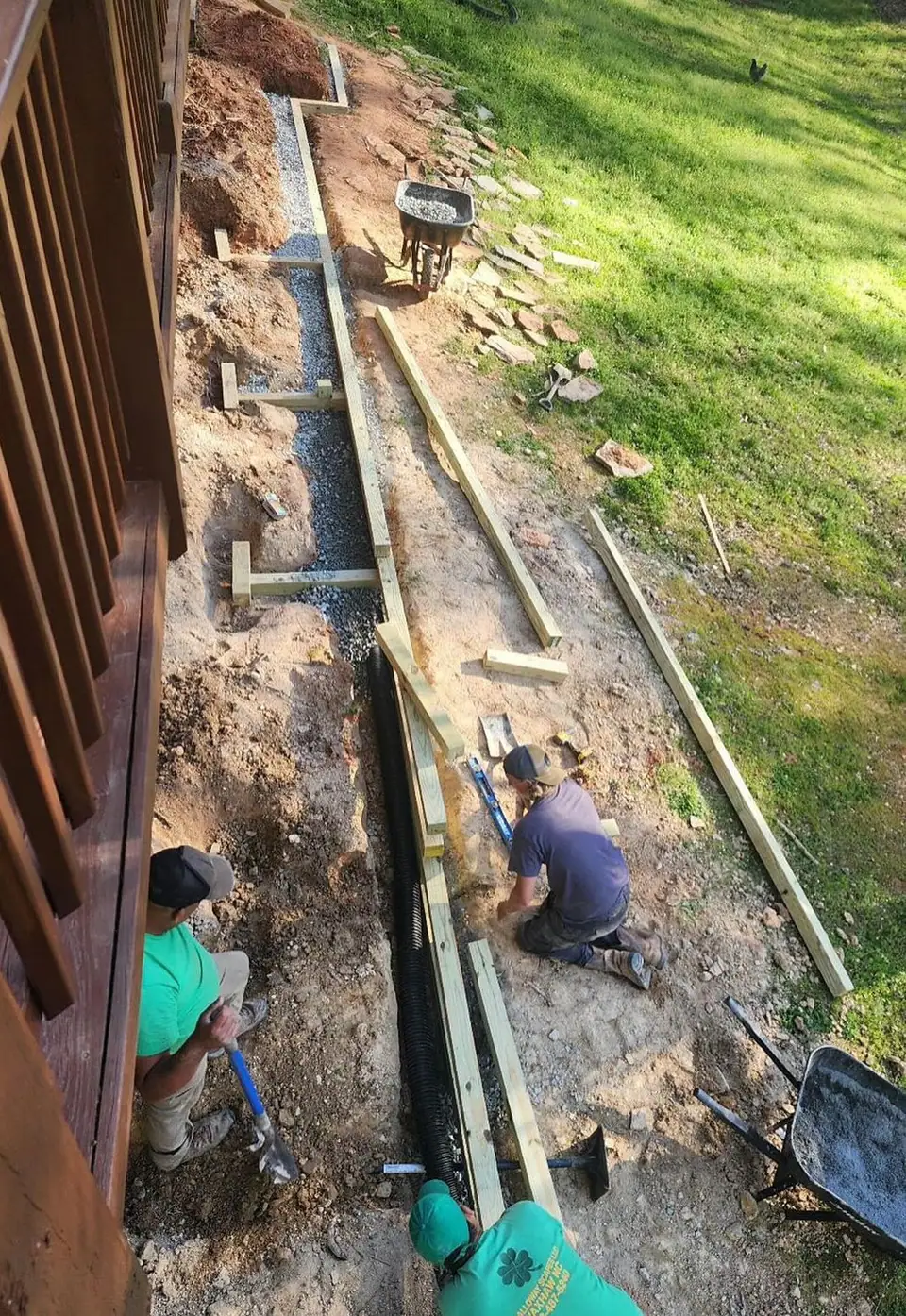
Utilities are marked through 811 first. Each downspout is connected to a fitting at ground level, and a trench is cut to the outlet with a continuous downward slope so water drains by gravity and doesn't sit in the line. Smooth-wall solid pipe is set in the trench. Corrugated pipe is cheaper but clogs and crushes more easily, so we prefer smooth-wall pipe for roof water.
Connections are glued or sealed, the line is tested by running water through it, and the trench is backfilled, compacted and restored with turf or mulch. Cleanouts are added where long runs or multiple downspouts join so the line can be flushed in the future.
03Where can downspout water go?
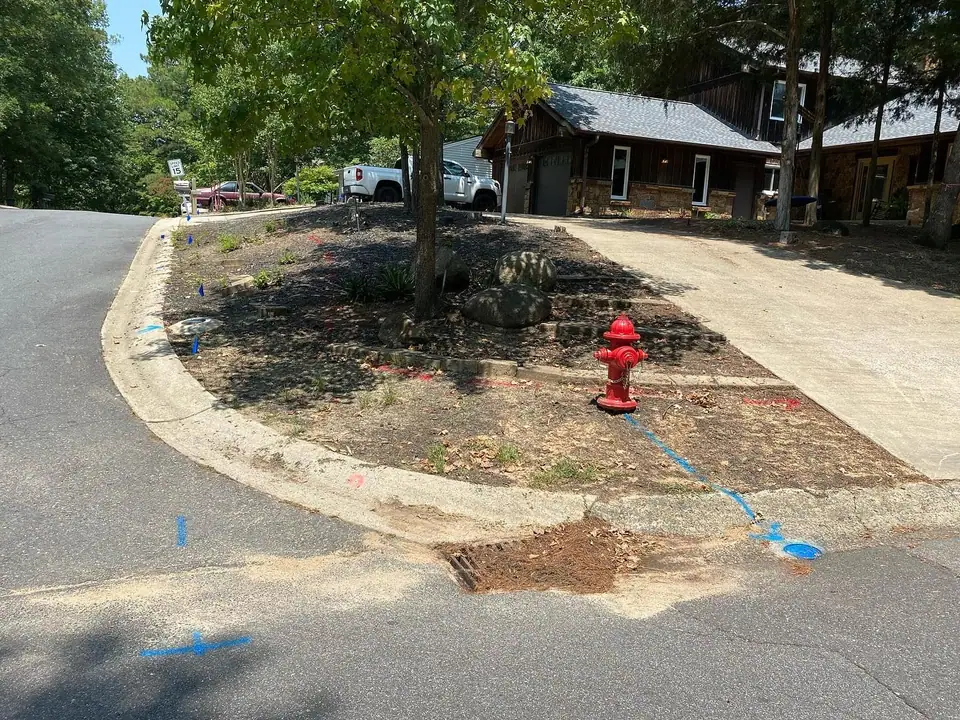
On many lots, water is piped to a pop-up emitter set in the lawn well away from the house, where it bubbles out and spreads across the turf. On sloped lots, a daylight outlet releases water at a lower point on the property. Some homes can discharge to the curb, where local rules allow. In every case, the outlet must be lower than the inlet and must not send concentrated water onto a neighbor.
Because clay soil absorbs water slowly, dry wells and buried pits tend to fill up and back up, so they are used only where soil conditions suit them.
04Can downspouts tie into a French drain?
Generally, they shouldn't share a perforated pipe. A French drain is designed to collect groundwater slowly through its perforations. Dumping a fast flood of roof water into it can overwhelm the drain and push water back out into the soil you are trying to dry out. The best practice is separate lines: solid pipe for downspouts and perforated pipe for groundwater, which may run in the same trench and join only at the outlet.
05How do you maintain a downspout drainage system?
Keep gutters clean, especially after fall leaf drop, since leaves and shingle grit are what clog buried lines. Gutter guards help. Check that pop-up emitters open freely and aren't buried under mulch or thatch. If a downspout starts overflowing at the connection during storms, the line may be partially clogged and can be flushed through the cleanout. Leaf removal visits from Galloway Scapes include clearing leaves from emitters and ground-level inlets.
How it works
Four steps. No surprises.
From the first call to the final cleanup, you deal with the same owner-run crew.
01
Call or send the form
Tell us what’s bothering you about the yard. We get back to you within 24 hours.
02
Walk the property
We look at slope, soil, drainage paths, turf type and how you actually use the space. No guessing from a photo.
03
A written estimate
You get a plain-language scope and price. No surprise add-ons after the crew shows up.
04
Owner-led work and cleanup
Terry is on the job. Beds edged, debris hauled off and the driveway blown clean before we leave.
Buried downspout cost depends on the number of downspouts, the total length of pipe needed to reach a safe outlet, the type of outlet, the depth and difficulty of trenching through clay or rock, whether lines must pass under walks or driveways, and how much lawn and landscape must be restored. One downspout piped a short distance to a pop-up emitter is a small job; a whole-house system with several downspouts joined into a main line is larger. Galloway Scapes walks the property, traces each downspout, identifies the best outlet and provides a free written estimate so you know exactly what will be installed.
How far should downspouts drain from the house?
A common guideline is to discharge roof water at least several feet from the foundation, and farther is better on clay soils, which absorb water slowly and swell when saturated. Splash blocks that release water only a foot or two from the wall do very little. Buried downspout systems typically carry water well out into the lawn, to a lower point on the lot, or to the curb where allowed, so it can't soak back toward the house. The right distance depends on your lot's slope, soil and available outlets. The key is that the water ends up somewhere lower than the house that won't cause a new problem for you or a neighbor.
Are pop-up emitters a good idea?
Pop-up emitters are a practical outlet for many buried downspout systems. When water flows through the line, pressure lifts the emitter's lid and water spreads across the lawn; when flow stops, the lid closes to keep debris and pests out. They work best when the emitter is lower than the downspout, the line slopes consistently, and the emitter is set in a spot where water can spread and drain away rather than in a low area that already floods. They need occasional checks to make sure grass, mulch or leaves haven't buried the lid. On sloped lots, a daylight outlet is often an even better option.
Why is my buried downspout overflowing?
When water backs up and overflows at the downspout connection, the buried line is usually partially clogged or the outlet is blocked. Common causes include leaves and shingle grit washed down from gutters, crushed or sagging corrugated pipe, roots entering joints, a pop-up emitter buried under soil or mulch, or a line installed without enough slope so sediment settles. The fix may be flushing the line through a cleanout, clearing the emitter, or replacing a damaged section with smooth-wall pipe at the proper slope. Galloway Scapes can diagnose an existing system and repair or replace it as needed.
Should downspouts connect to a French drain?
In most cases, downspouts should not empty into a French drain's perforated pipe. A French drain is designed to collect groundwater gradually through its perforations, and a sudden surge of roof water can overwhelm it and push water back out into the surrounding soil, often right where you are trying to keep things dry. The better approach is to run roof water in its own solid pipe, which can share a trench with the French drain and join it only at the outlet. That keeps both systems working as intended. Galloway Scapes designs downspout and French drain systems together when a property needs both.
We had several landscaping projects completed at our property, including new sod installation, mulching, and drainage work, and I couldn’t be happier with how everything turned out. The sod installation completely transformed the appearance of our yard.Cameron JonesSod, mulch & drainage
★★★★★
We contacted Galloway Scapes for lawn leveling and are very pleased with their service. Terry and his crew are incredible and did a great job on our lawn! They arrived on schedule and did a thorough job.Marianne NietoLawn leveling
★★★★★
Terry and his crew are the best! He is attentive, professional, and knowledgeable. I have a fast growing weed in my lawn and he works diligently on keeping it under control.Debbie HeilemannLawn care
★★★★★
Reliable, efficient, and professional, with great attention to detail. Everything looked clean, green, and well cared for.Blake TrewLandscaping
★★★★★
Very good, consistent service. They are responsive when asked about things and address concerns as they arise.David DeaconLawn maintenance
★★★★★
Reliable, punctual, creative, clean, and professional throughout the process. I really appreciated how easy they made everything.Ryan BrzyckiLandscaping
★★★★★
Knowledgeable and skilled approach to lawn maintenance and yard landscaping, with meticulous attention to detail. Fair pricing combined with outstanding results.Noelle IsheeLawn & yard landscaping
Free estimate
Tell us about your downspout drainage systems project.
A few quick details. We reply within 24 hours, usually sooner, and we walk the property before we price anything.