★★★★★ 4.9 on Google · 16 reviewsLicensed, bonded & insuredOwner on every jobFree written estimates
Our approach
How we approach french drain installation.
A French drain is a trench lined with filter fabric, bedded in washed gravel, with perforated pipe at a steady fall to a real outlet. Get the slope or outlet wrong and it becomes an underground puddle. We shoot grades, plan the outlet first and restore the surface when we’re done.
French drains work best for saturated soil and groundwater. If water is running across the surface toward your house, we’ll likely pair the drain with regrading or a swale.
French drain installation in Waxhaw, NC: how a drain that lasts is built
The short answer
A French drain is a gravel-filled trench with a perforated pipe that collects groundwater and carries it by gravity to a safe outlet. A drain that lasts in red clay needs a trench sloped consistently downhill, filter fabric to keep clay out, washed stone around the pipe, a lower outlet that won't flood a neighbor, and lawn restoration on top.
01How does a French drain work?
Water always takes the easiest path. A trench filled with washed gravel offers a much easier path than surrounding clay, so groundwater flows into it. A perforated pipe at the bottom of the trench collects that water and carries it downhill to an outlet. The fabric wrapped around the stone and pipe lets water in while keeping fine clay particles out, which is what prevents the drain from clogging over time.
French drains are designed for subsurface water, ground that stays soggy, seeps or holds water below the surface, rather than large volumes of surface runoff, which are handled with grading and catch basins.
Trench: dug to depth with a continuous downhill slope
Fabric: non-woven filter fabric lines the trench
Stone: washed gravel bed beneath and around the pipe
Pipe: perforated pipe, holes oriented for collection
Outlet: daylight, curb or other safe low point
Restore: fabric wrapped, backfilled and turf replaced
02Why do French drains fail?
Most failures come back to a few shortcuts. Without filter fabric, clay migrates into the stone and pipe and the drain silts up within a few years. Without consistent slope, water sits in the pipe and sediment settles. Without a real outlet, the drain simply fills and stops working. Using rounded pea gravel or dirty stone reduces flow. And dumping roof water into a French drain can overwhelm it.
Every one of those shortcuts saves money on installation day and costs far more when the drain has to be dug up and redone.
03Where are French drains used?
Common locations include along the uphill side of a house to intercept groundwater before it reaches the foundation, across a soggy section of lawn, at the base of a slope where water seeps out, behind retaining walls to relieve water pressure, and along property lines where water arrives from a neighboring lot. The route is planned around where the water is coming from and where it can safely go.
04How is a French drain installed?
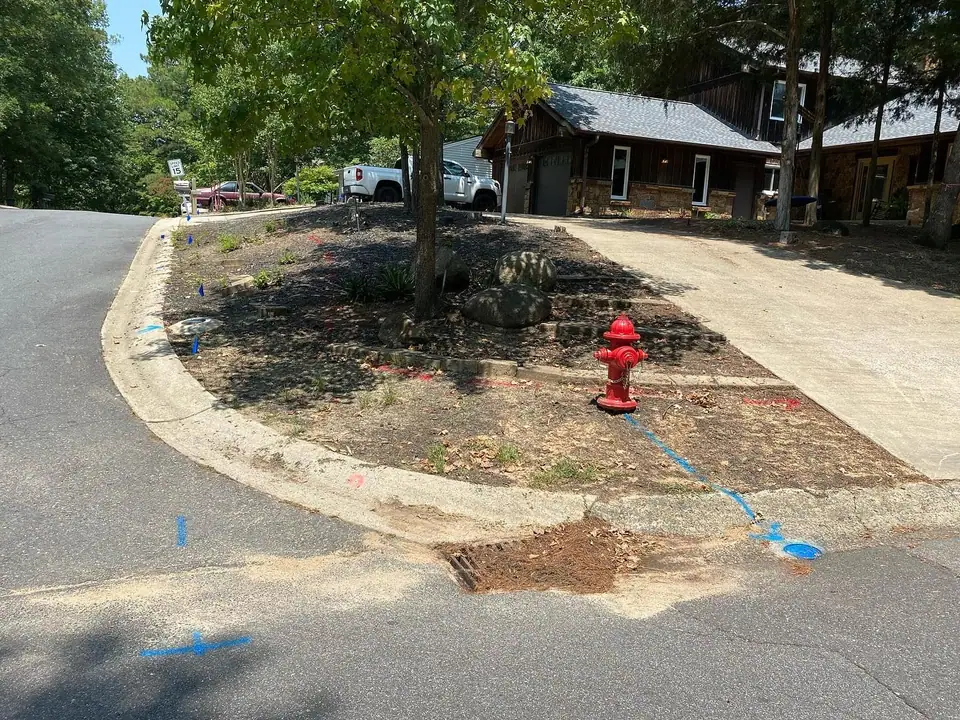
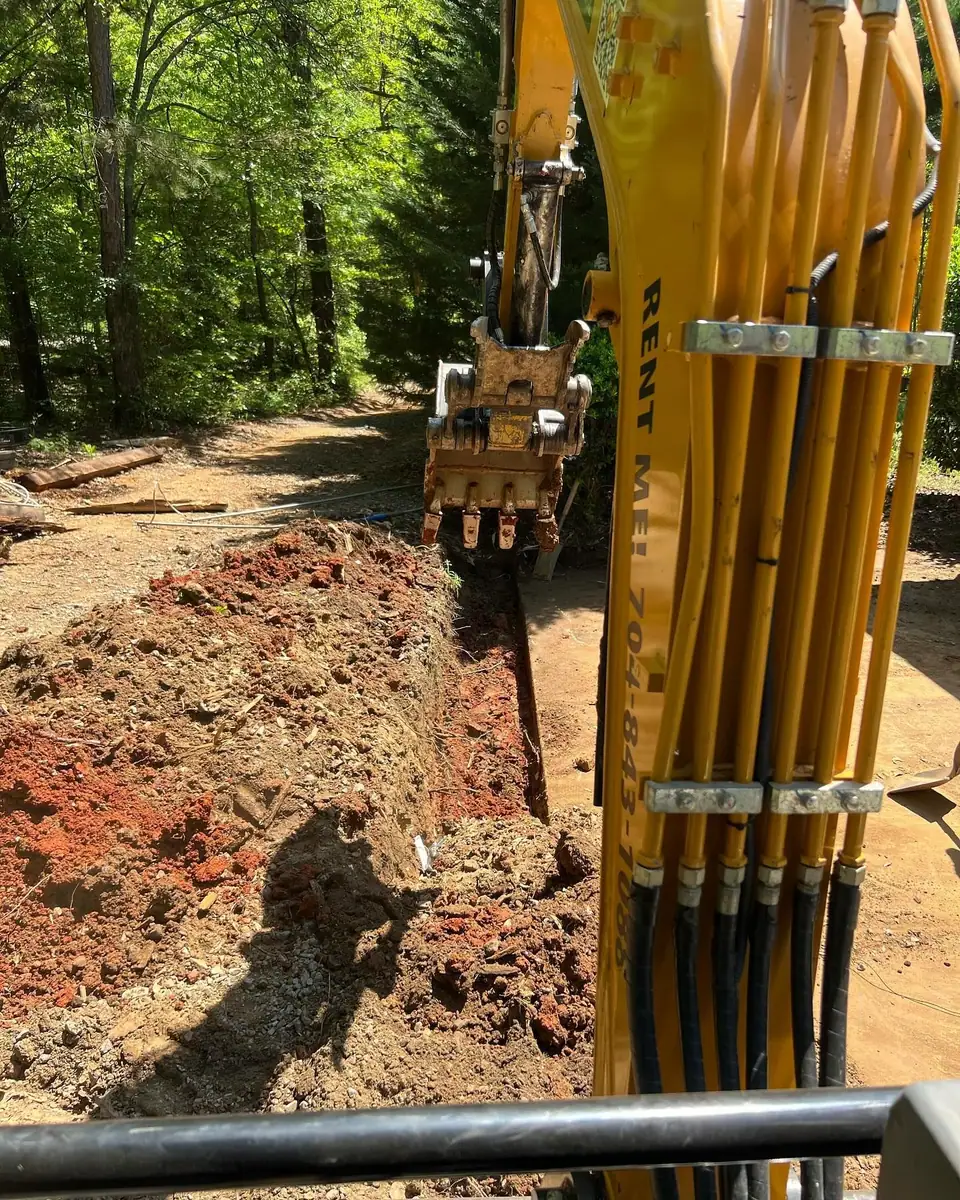
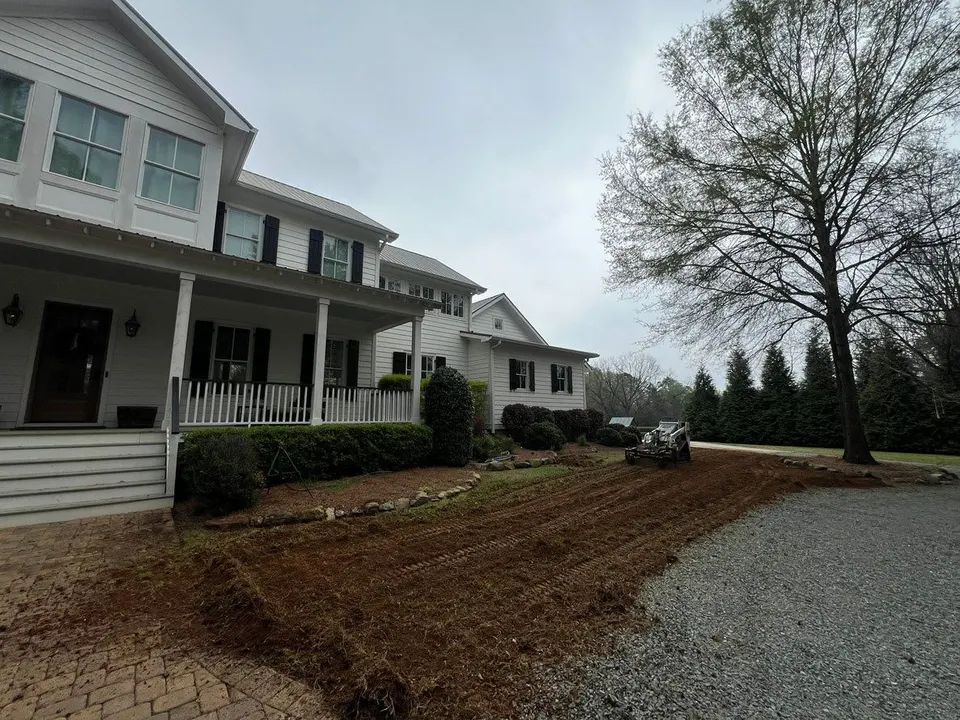
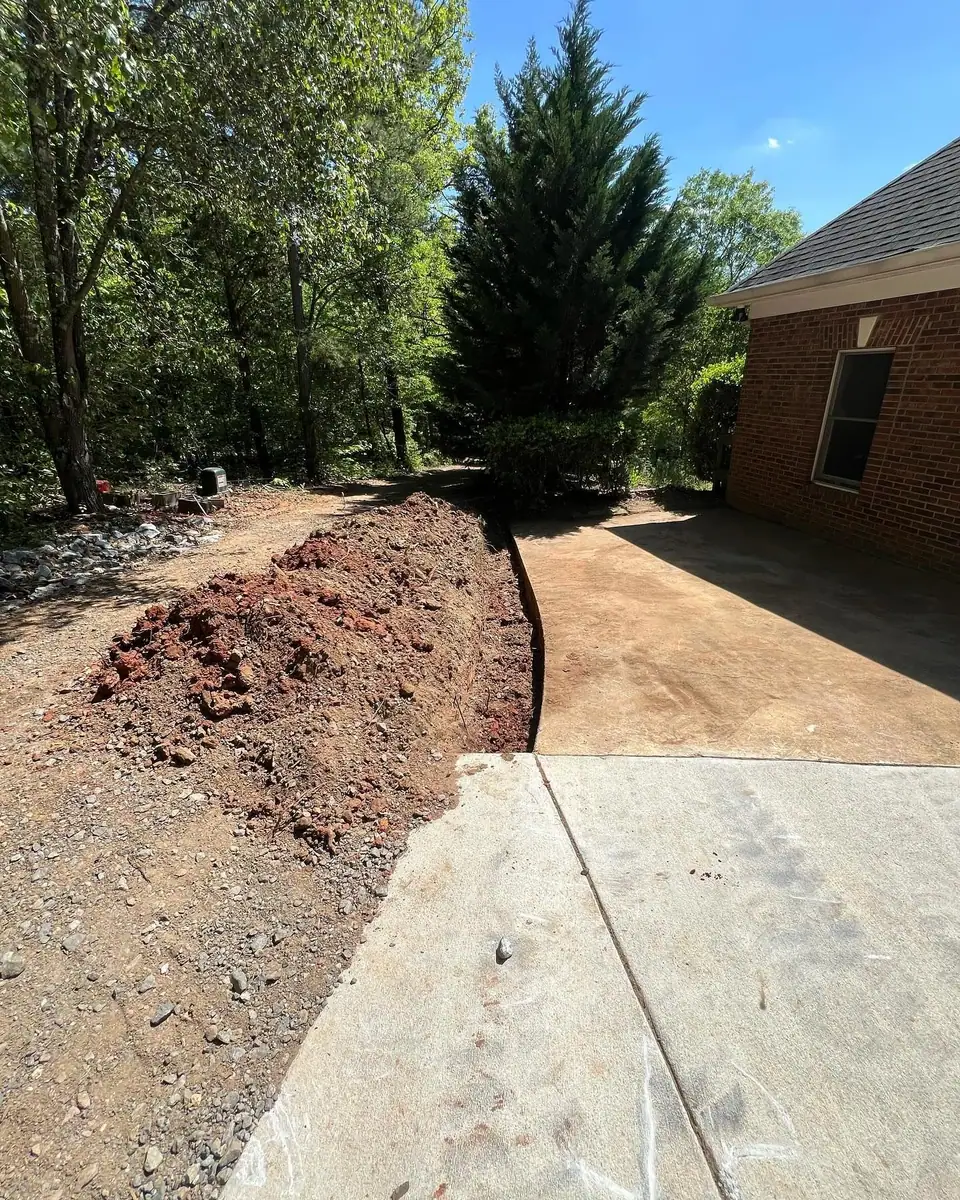
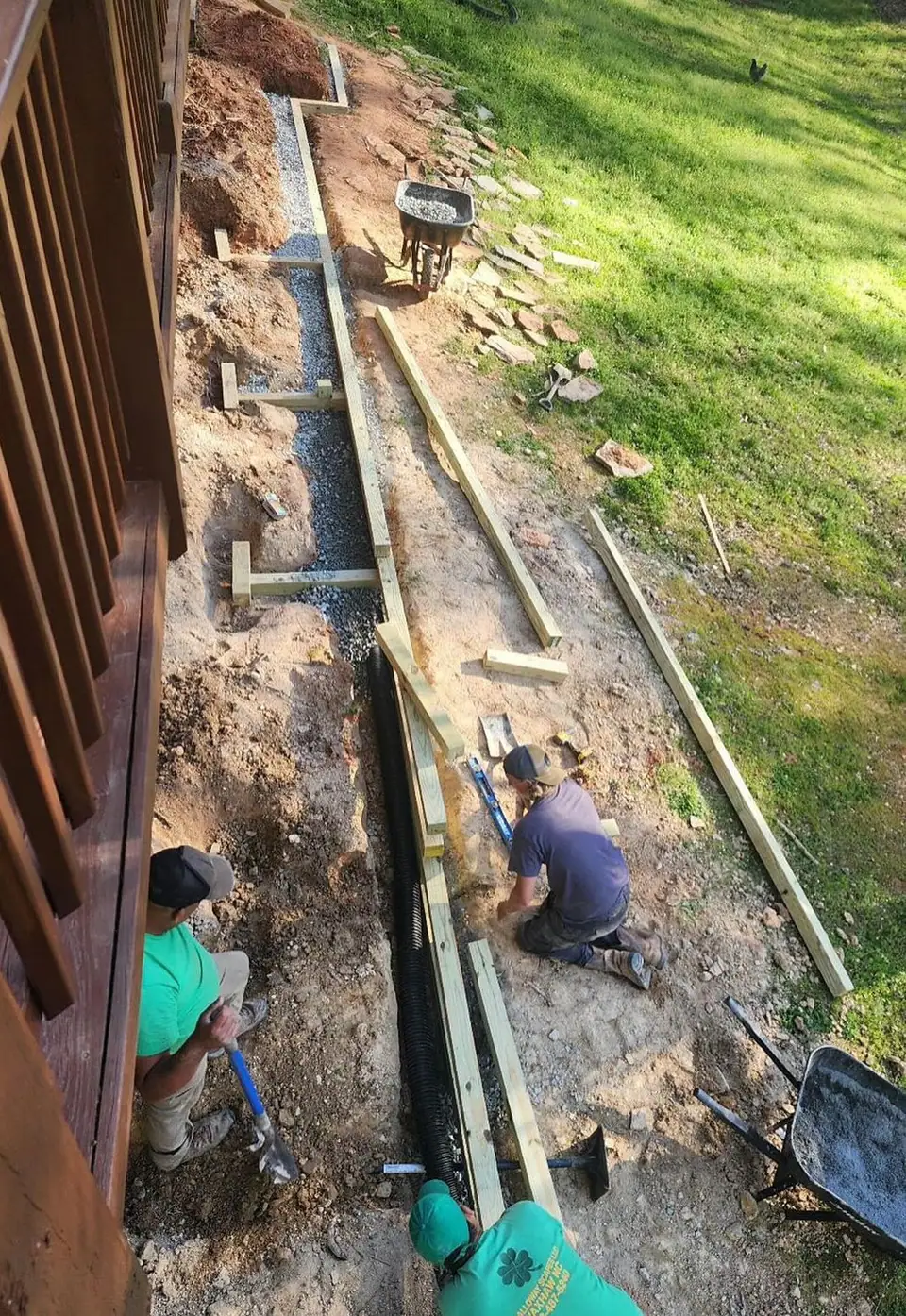
Utilities are located through 811 first. The route is marked and sod is cut and set aside where it can be reused. The trench is excavated with our own equipment, and its slope is checked along its length. Fabric lines the trench, a bed of washed stone goes down, the perforated pipe is set, and more stone surrounds it. The fabric is wrapped over the top, the trench is capped with soil, and the lawn is restored with sod or seed.
The outlet is built so water exits cleanly, with a grate, pop-up or rock apron where needed to prevent erosion. Finally, the system is tested with water.
05Do French drains need maintenance?
A properly built French drain needs very little. Keep the outlet clear of leaves, mulch and debris, and avoid planting trees with aggressive roots directly over the line. Where a cleanout is installed, the pipe can be flushed if flow ever slows. Most problems with older drains come from missing fabric or lack of slope, which isn't fixable with maintenance alone.
How it works
Four steps. No surprises.
From the first call to the final cleanup, you deal with the same owner-run crew.
01
Call or send the form
Tell us what’s bothering you about the yard. We get back to you within 24 hours.
02
Walk the property
We look at slope, soil, drainage paths, turf type and how you actually use the space. No guessing from a photo.
03
A written estimate
You get a plain-language scope and price. No surprise add-ons after the crew shows up.
04
Owner-led work and cleanup
Terry is on the job. Beds edged, debris hauled off and the driveway blown clean before we leave.
French drain cost depends mainly on the length of the drain, the trench depth, the distance to a safe outlet, soil and rock conditions, access for equipment, whether the route crosses walks, beds or irrigation lines, and how much lawn and landscape must be restored. Specialty outlets, cleanouts and connecting catch basins add to the scope. Because a drain is only as good as its slope and outlet, Galloway Scapes doesn't quote French drains by the foot over the phone. Terry walks the property, confirms where water is coming from and where it can go, and provides a free written estimate with the route and materials.
How deep should a French drain be?
French drain depth depends on what the drain is intended to do. Drains that collect surface-level groundwater across a soggy lawn are often relatively shallow, while drains that intercept water before it reaches a foundation, or that relieve water behind a retaining wall, may need to be deeper. More important than any single depth is that the trench slopes continuously downhill from its high end to the outlet, so water never sits in the pipe. On the walkthrough, Terry evaluates where water enters the soil, the grade of the lot and the outlet elevation, then sets the depth and slope that will make the drain work for your property.
Do French drains work in clay soil?
Yes, French drains work well in clay soil when they are built correctly, and they are one of the most common drainage solutions in the Charlotte region. The keys are filter fabric to keep fine clay particles from migrating into the stone and clogging the pipe, clean washed stone that allows water to flow freely, a consistent downhill slope, and a real outlet lower than the drain. Because clay absorbs water slowly, the drain must carry water to an outlet rather than relying on it soaking into the ground at the end. Drains built without fabric or a proper outlet are the ones that fail in clay within a few years.
How long does a French drain last?
A properly built French drain with filter fabric, washed stone, quality pipe, consistent slope and a clear outlet can last for decades with minimal maintenance. Drains fail early when shortcuts are taken: no fabric, so clay silts up the stone and pipe; inadequate slope, so sediment settles; dirty or rounded stone that reduces flow; roof water dumped into the system; or an outlet that becomes buried or blocked. Keeping the outlet clear and avoiding trees with aggressive roots directly above the line helps the drain perform for the long run.
What is the difference between a French drain and a catch basin?
A French drain collects groundwater from the soil through a perforated pipe buried in gravel. It is the right solution when ground stays soggy and saturated below the surface. A catch basin collects surface water through a grate at the lowest point of a yard or driveway and sends it through solid pipe to an outlet. It is the right solution when water pools on the surface during and after storms. Many properties need both: a catch basin at a low spot to handle storm runoff and a French drain to dry out the surrounding soil, often running to the same outlet. Galloway Scapes recommends the right combination after seeing how water moves on your property.
We had several landscaping projects completed at our property, including new sod installation, mulching, and drainage work, and I couldn’t be happier with how everything turned out. The sod installation completely transformed the appearance of our yard.Cameron JonesSod, mulch & drainage
★★★★★
We contacted Galloway Scapes for lawn leveling and are very pleased with their service. Terry and his crew are incredible and did a great job on our lawn! They arrived on schedule and did a thorough job.Marianne NietoLawn leveling
★★★★★
Terry and his crew are the best! He is attentive, professional, and knowledgeable. I have a fast growing weed in my lawn and he works diligently on keeping it under control.Debbie HeilemannLawn care
★★★★★
Reliable, efficient, and professional, with great attention to detail. Everything looked clean, green, and well cared for.Blake TrewLandscaping
★★★★★
Very good, consistent service. They are responsive when asked about things and address concerns as they arise.David DeaconLawn maintenance
★★★★★
Reliable, punctual, creative, clean, and professional throughout the process. I really appreciated how easy they made everything.Ryan BrzyckiLandscaping
★★★★★
Knowledgeable and skilled approach to lawn maintenance and yard landscaping, with meticulous attention to detail. Fair pricing combined with outstanding results.Noelle IsheeLawn & yard landscaping
Free estimate
Tell us about your french drain installation project.
A few quick details. We reply within 24 hours, usually sooner, and we walk the property before we price anything.